Top Overhead Crane Manufacturers in India (2025)
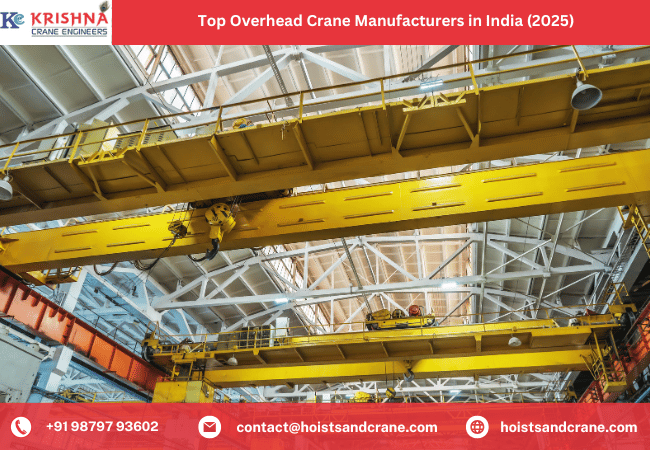
Anyone who has spent time walking beneath a factory ceiling, watching loads rise and shift with surprising calm, will understand why people talk about overhead crane manufacturers long before they discuss any other equipment. Those cranes, moving quietly along the length of a bay, end up shaping the whole workflow without making any noise about it. And in India, where industries grow quickly and at odd rhythms, the crane becomes part of the work routine almost like a background habit. Different factories use them in different ways, some for constant heavy lifting, some for slow careful moves, others simply because there is no better alternative.
The Indian Crane Market and Its Fast Changing Pace
India does not move in straight lines. One sector expands, another reconfigures its layout, and workshops keep shifting machines to make space for new units. This constant movement gives EOT Crane Manufacturers in India a unique challenge. They do not just build cranes, they build cranes that must fit into spaces that are already busy, crowded, or changing shape.
Some places want Double Girder EOT Crane Manufacturers because of heavier loads. Others prefer Single Girder EOT Crane Manufacturers for smoother operations. Larger yards work with Gantry Crane Manufacturers in India who understand outdoor lifting better than anyone else. Smaller assembly areas rely on JIB Crane Manufacturers in India for tight corners where horizontal rotation matters more than long travel.
Names That Appear Again and Again
The landscape has many strong Overhead Crane Manufacturers in India who work with different industries that have completely different expectations. Some companies specialise in fitting cranes into older buildings, others work with wider spans that stretch from one end of the workshop to another. Goliath Crane Manufacturers supply cranes for shipyards or bigger fabrication yards where indoor structures cannot carry heavy beams. Material Handling Equipment Manufacturers fill the spaces in between with lifters and conveyors, creating something close to a complete lifting ecosystem.
What Makes a Crane Manufacturer Dependable
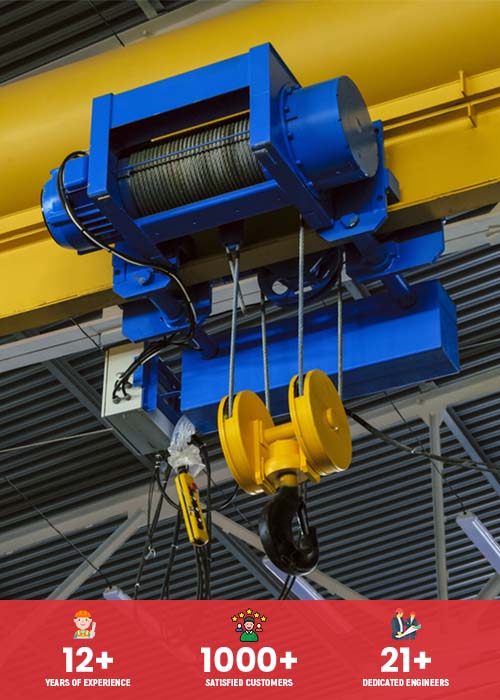
A crane may lift twenty tons on paper but still feel unstable if the movement is not aligned well. Industrial Crane Manufacturers often mention that the real test is not the lifting, it is how the crane behaves while traveling under load, how evenly the trolley moves, whether the wheels stay true to the track, and if the controls respond gently or too sharply.
Reliable manufacturers tend to focus on the small things. The tolerances in the rail, the smoothness of the end carriage, the grip of the braking system, the wiring around the control panel, these pieces decide whether the crane will run smoothly for years or demand constant adjustments.
How Cranes Fit Into Everyday Factory Life
Inside a working plant, the crane becomes a quiet presence, almost part of the building itself. Workers grow familiar with the sounds, the small pauses, the beginning and end of travel, even the way the hook steadies when lowered.
Different industries use cranes in very different ways. Some pull heavy pieces slowly, others move materials back and forth at a fast rhythm. Some industries change lifting positions constantly, others stick to fixed points daily. A good crane handles all these patterns without drawing attention to itself. The more invisible the crane feels, the better the manufacturer usually is.
Installation, Space, and Real World Challenges
Installation is where manufacturers show their real experience. A crane may look perfect on paper but fail to fit comfortably inside a real building unless someone has checked every detail beforehand. Some factories need cranes installed above existing machines. Some cannot pause production. Some buildings have uneven columns or low roof points that complicate alignment. One installed poorly disrupts the flow in ways that workers notice immediately.
Maintenance and What Happens After Installation
A crane is only as reliable as the care it receives over time. Motors heat up, wheels wear out, limit switches need checking, wires loosen after long periods of movement. The best manufacturers not only install cranes but also prepare clients for long term maintenance. Factories that maintain a simple routine, checking basic components, cleaning rails, inspecting braking systems, often enjoy cranes that last decades. Those that ignore these checks usually face problems at the worst possible times.
Conclusion
India’s crane market in 2025 looks busy, wide, and full of options, and factories depend heavily on machines that can move loads safely and repeatedly without slowing down. The manufacturers who understand daily factory life, the unpredictability of industrial spaces, and the shifting demands of production become the ones people trust the most. And when companies face the final decision, they often lean toward experienced overhead cranes manufacturers who can guide them toward a crane that blends naturally into the work instead of becoming a constant concern.