
Indian Standards Checklist for Overhead Crane Safety and Compliance
When a factory installs a crane, most people think about lifting capacity and delivery time. Very few sit down and study the Indian Standards that control safety and design. That is where problems quietly begin. A crane may look strong from outside, but if it does not follow IS rules, it can create risk for workers and management. Many overhead crane manufacturers in India talk about compliance, but as a buyer or plant head, you should also understand what to check. A clear compliance checklist helps you stay safe, avoid penalties, and make sure your crane performs reliably for many years.
IS 3177 and Basic Design Rules
IS 3177 is one of the main standards that guides overhead crane design in India. It explains how the crane structure should be calculated and how much safety margin must be included. The girder should not be designed exactly equal to rated load. It must handle more than that for safety. The standard also talks about correct material selection and welding quality. If the plate thickness or material grade is wrong, the crane may look fine at first but weaken over time. That is why proper design calculations and drawings should
Structural Strength and Load Consideration
A crane does not only lift weight, it also creates impact force. When a load starts moving, stops suddenly, or swings slightly, extra stress develops in the structure. IS standards consider these forces during the design stage. The runway beams, end carriages, and columns must be strong enough to handle vertical and horizontal loads. Even braking creates side force on the structure. Deflection limits are also defined. If the girder bends too much during lifting, it indicates weakness. Structural compliance is not about appearance, it is about long term strength under daily working conditions inside the factory.
Wire Rope Inspection and Replacement Limits
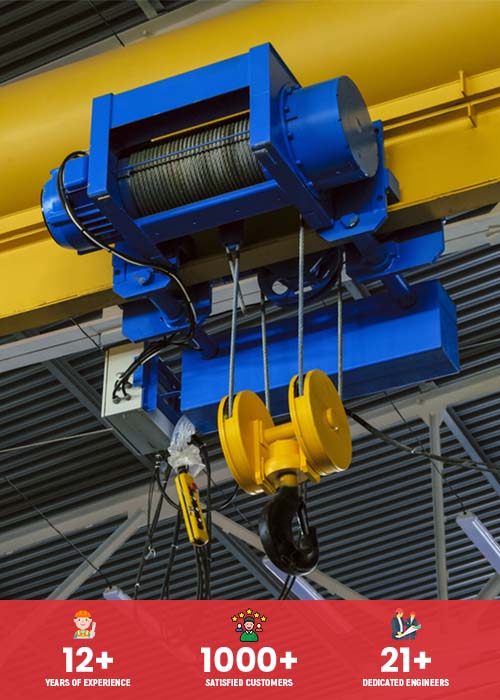
Wire rope carries the full load weight, so its condition must be checked regularly. IS guidelines clearly mention visual inspection of rope before operation. Broken wires, rust, flattening, or reduced diameter are warning signs. If rope wear crosses the allowed limit, replacement should not be delayed. Rope drum winding should also be checked to ensure smooth layering. Sudden jerks or uneven winding increase wear. A simple daily check takes only a few minutes but prevents major accidents. Many failures happen because small rope damage was ignored for weeks. A proper checklist keeps this under control.
Hook Condition and Safety Checks
The hook may look like a simple part, but it is critical for safety. IS rules require inspection of hook throat opening and surface cracks. If the hook opening increases beyond limit, it means metal is stretched. That hook should be replaced immediately. There should also be a safety latch to prevent load from slipping out. Regular non destructive testing may be required for heavy duty cranes. Hook rotation should be smooth without obstruction. Since every load passes through this part, even minor damage should never be ignored. A small crack can grow silently under repeated lifting cycles.
Brake Performance and Limit Switch Testing
A crane can look perfectly fine from the outside, but if the brakes are weak, it is never safe. The brake is what holds the load in place after lifting. If it slips even a little, the load can slowly come down without warning. That is why brake checking should never be skipped. During inspection, the hoist brake must be tested with the rated load to confirm it holds firmly. There should be no downward movement once lifting stops. Travel brakes should also bring the crane to a smooth stop without sudden shock. Limit switches must cut off motion before over travel happens. Regular testing keeps everything under control.
Load Testing Before Commissioning
IS standards require proof load testing above rated capacity to confirm structural safety. It should remain within the allowed limit and return to normal after load removal. All crane movements should be tested under load. Hoisting, cross travel, and long travel must run smoothly. After testing, a proper report should be prepared and signed. Without a load test record, compliance remains incomplete. Commissioning is the stage where design theory is verified in real working condition.
Conclusion
IS standards are practical safety tools, not just technical papers. When factories follow a proper compliance checklist, they reduce accident risk and improve equipment life. Ignoring standards may save small money today but can create serious problems tomorrow. A crane works above people every day. That responsibility should never be taken lightly. Strong structure, safe wiring, trained operator, and regular inspection together create a compliant and dependable lifting system for any industry.