
The Difference Between Hoists and Cranes
Hoists and cranes are both important lifting tools used in industries, factories, warehouses, and construction sites. While they may look similar, they serve different purposes. Understanding these differences helps you choose the right equipment for your workplace.
What Is an Overhead Crane?
An overhead crane is a powerful and advanced lifting system used to raise, lower, and move heavy materials across a large area.
It includes several components that work together to provide full movement across your production floor.
Key parts of an overhead crane:
- Hoist – lifts and lowers the load
- Trolley – moves the hoist horizontally
- Bridge – spans the work area and supports the trolley
- Runway – allows the bridge to travel across the workspace
Together, these parts give cranes multidirectional mobility — up, down, left, right, forward, and backward.
Common types of overhead cranes:
- Top-running cranes
- Under-running cranes
- Gantry cranes
- Monorail cranes
These are usually classified based on their design, structure, and operating method.
What Is a Hoist?
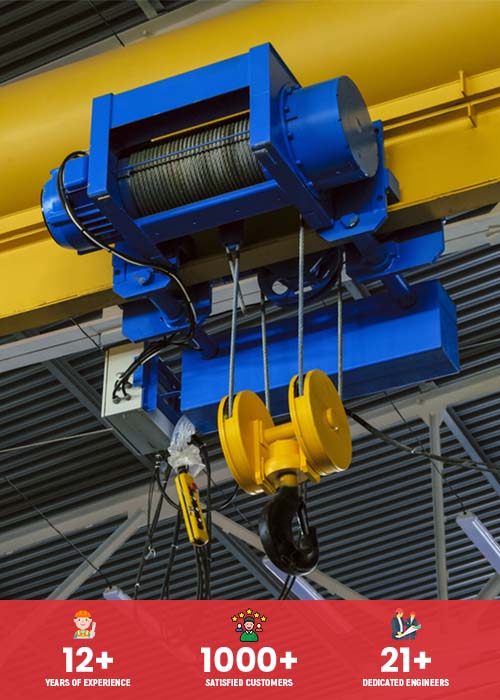
A hoist is a lifting device designed for one main job: raising and lowering a load vertically
A hoist can be mounted:
- On a fixed point, or
- On a trolley, which allows it to move horizontally when installed on a crane’s bridge girder
Types of hoists:
- Wire rope hoist → Best for loads above 5 tonnes
- Chain hoist → Ideal for loads below 5 tonnes with low maintenance
Hoists are classified by:
- Lifting medium (wire rope or chain)
- Power source (electric, manual, pneumatic)
- Suspension type (hook, lug, trolley-mounted)
Key Differences Between Hoists and Cranes
1. Range of Motion
- Hoists:
- Move loads only vertically
- Move loads only vertically
- Cranes:
- Provide both vertical and horizontal movement
- Cover a large working area
- Provide both vertical and horizontal movement
2. Structure and Components
| Feature | Hoist | Crane |
| Main function | Lift/lower vertically | Lift + move across workspace |
| Components | Drum, chain, rope, hook | Hoist, trolley, bridge, runway |
| Complexity | Simple | More complex |
3. Working Range
- Hoists are suitable for small, fixed areas where vertical lifting is needed.
- Cranes work well in large production environments because they can move loads in multiple directions.
EOT cranes, gantry cranes, and similar systems can cover:
- Up/down
- Left/right
- Forward/backward
This makes cranes ideal for wide-area material handling.
4. Flexibility in Operation
- Hoists perform a single lifting task efficiently.
- Cranes can be equipped with multiple tools and attachments such as grabs, magnets, and spreader beams to handle different materials.
5. Applicability
Hoists are ideal for:
- Workshops
- Small warehouses
- Maintenance areas
- Limited spaces
Cranes are ideal for:
- Construction sites
- Large factories
- Mining operations
- Freight terminals
- Heavy industrial applications
Cranes typically handle heavier loads and provide greater mobility.
Choosing Between a Hoist and a Crane
When selecting the right equipment, consider the following:
1. Load Capacity
- Light, vertical-only loads → Hoist
- Heavy loads + long-distance movement → Crane
2. Available Space
- Compact areas → Hoist
- Large, open workspace → Crane
3. Movement Requirement
- Only up–down motion → Hoist
- Multi-directional movement → Crane
Summary: Hoist vs. Crane
| Feature | Hoist | Crane |
| Movement | Vertical only | Vertical + horizontal |
| Load capacity | Generally lower | Medium to very high |
| Installation | Simple & compact | Large and structured |
| Best for | Small lifting tasks | Large-scale industrial movement |
Final Note
Understanding how hoists and cranes differ helps you communicate clearly with manufacturers and choose the right lifting equipment for your operation. If you need more help selecting the best option for your workspace, feel free to reach out anytime.