
Jib Crane Design: Types, Components, and Modern Standards Explained
Jib cranes are among the most practical and space-efficient lifting solutions used across Indian manufacturing and industrial facilities. From small workshops to large production plants, jib cranes help improve material handling efficiency, workplace safety, and operational productivity.
As one of the trusted jib crane manufacturers in India, Hoists & Cranes designs and supplies customised jib crane solutions for industries across Ahmedabad, Gujarat, and PAN India. This guide explains jib crane design principles, types, components, safety standards, and modern innovations to help businesses choose the right system.
In this in-depth guide, I’ll break down how jib crane design works, its components, available types, safety aspects, and modern trends influencing the market today.
What is a Jib Crane?
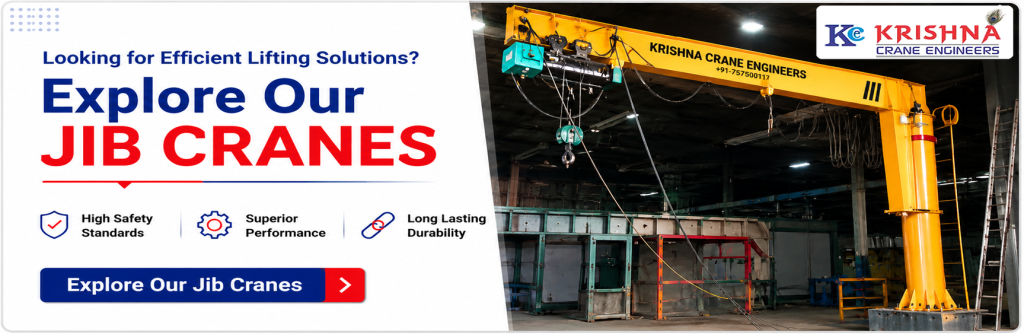
A jib crane is a type of crane with a horizontal arm (known as a jib or boom) that supports a hoist, typically mounted to a vertical mast or wall. This allows the crane to lift, move, and rotate loads within a circular or semi-circular area.
Jib cranes are known for their simplicity, low installation footprint, and flexibility compared to other overhead crane systems. According to Beaton Industrial, jib cranes are one of the most cost-effective lifting tools for light-to-medium duty material handling.
In Indian industrial environments, jib cranes are especially valued for their low installation cost, minimal floor space requirement, and flexibility. They are commonly used in workshops, assembly lines, warehouses, and maintenance bays where repetitive lifting is required.
Types of Jib Cranes by Design
There are several standard jib crane designs, each suited to specific needs. Let’s take a quick look:
Wall-Mounted Jib Crane
A wall-mounted jib crane is fixed to a building column or wall and rotates around a horizontal arm.
Best suited for: Space-restricted workshops and production lines in Ahmedabad, where floor space optimisation is critical.
Pillar-Mounted Jib Crane
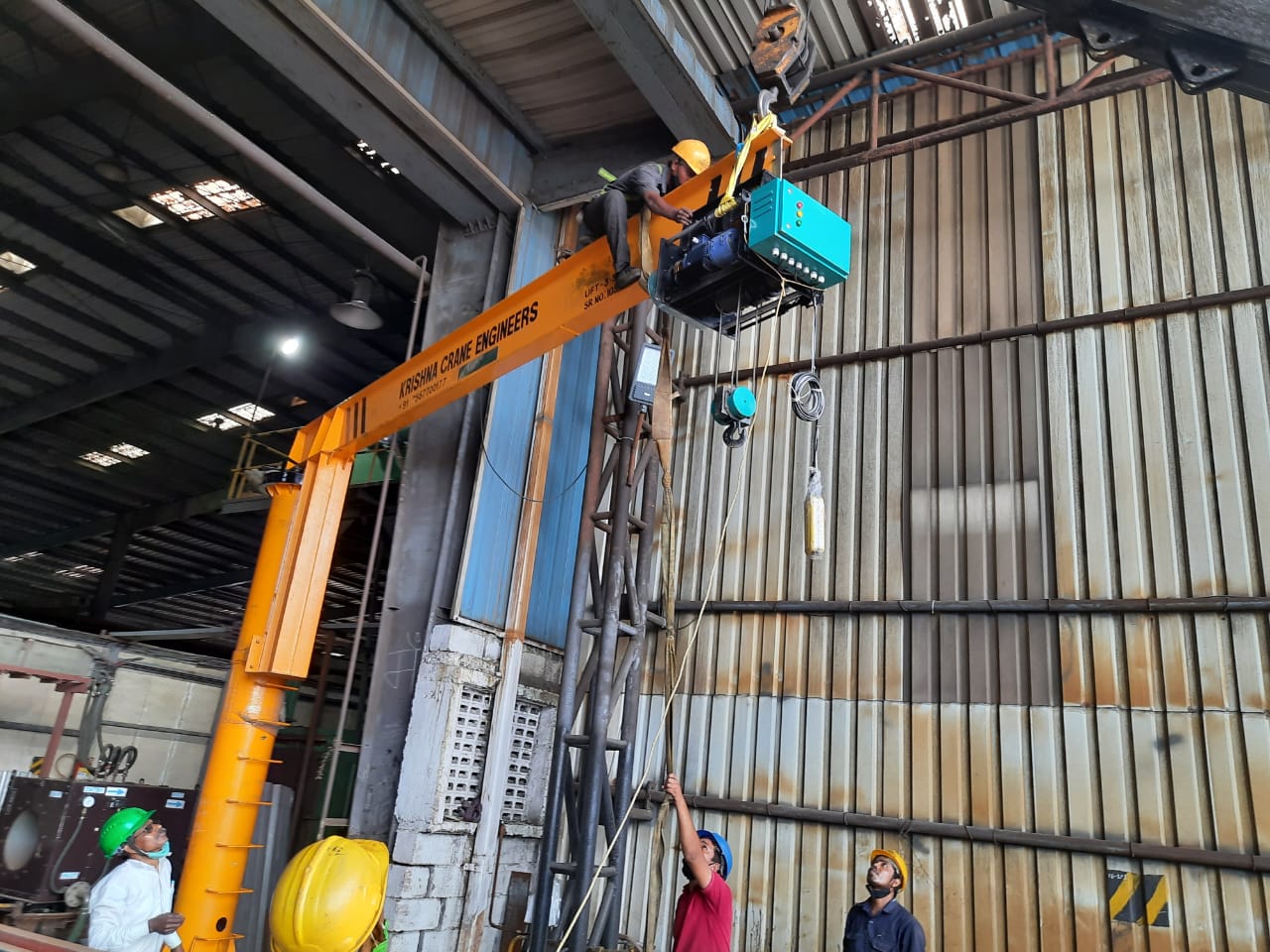
These cranes are supported by a vertical column anchored to the foundation.
Best suited for: Fabrication units, automotive workshops, and machine shops requiring repetitive lifting.
Articulating Jib Crane
Articulating jib cranes have two pivot points allowing greater flexibility.
Best suited for: Workstations with obstructions or irregular layouts where precise load positioning is needed.
Mast-Type Jib Crane
Mast-type jib cranes are supported by both floor and ceiling structures.
Best suited for: Heavy-duty lifting applications where building structure allows dual support without wall loading.
Portable Jib Crane
Portable jib cranes can be moved from one location to another.
Best suited for: Maintenance operations, temporary lifting tasks, and job-site applications.
According to a recent study published in IJPREMS, floor-mounted and wall-mounted types are among the most demanded in Indian manufacturing units due to their structural simplicity and lower installation costs.
Key Components of Jib Crane Design
A safe and efficient jib crane relies on carefully engineered components:
📌 Jib Arm (Boom) – The horizontal beam that carries the hoist.
📌 Column or Mast – The vertical support for floor-mounted models.
📌 Rotating Mechanism – Bearings or slewing gears for rotation.
📌 Hoist & Trolley – Mechanism for vertical lifting and horizontal travel.
📌 Foundation & Anchoring – Ensures the crane is stable and safe.
📌 Electrical Panel & Controls – For powered slewing or hoisting.
Mazzella Companies notes that properly specifying each of these components ensures smoother operations and reduced maintenance costs over the crane’s life cycle.
Design Standards and Load Calculations
In India, jib crane design follows standards such as IS 15419:2004 for pillar and wall-mounted types. This includes:
✅ Material strength
✅ Welding and bolting quality
✅ Load testing procedures
✅ Safe working loads
✅ Rotation angles
The Bureau of Indian Standards (BIS) clearly prescribes methods for moment calculations, weld size, and foundation depth to avoid structural failures.
As per AISC recommendations, designers should always check deflection limits (usually 1/150 of the span maximum) to prevent dangerous sway during operations.
Modern Jib Crane Design Innovations
🚀 Lightweight High-Strength Steel — cuts down weight without compromising capacity.
🚀 Modular Construction — allows faster installation and maintenance.
🚀 Smart Sensors — monitor overload, tilt, or motor temperatures in real-time.
🚀 Compact Wall Mounts — ideal for crowded factories and small shops.
🚀 Remote-Control Operation — boosts safety and productivity.
According to the India Crane Market 2024 report, these innovations are driving a 7% CAGR growth in the jib crane segment through 2030, especially in sectors like warehousing and automotive.
Applications of Jib Cranes
Jib cranes serve industries such as:
✅ Automotive
✅ Shipbuilding
✅ Heavy fabrication
✅ Warehousing
✅ Railways
✅ General engineering
In Ahmedabad, jib cranes are widely used across textile manufacturing, engineering workshops, pharmaceutical warehouses, automotive ancillary units, and infrastructure maintenance facilities.
They’re perfect for repetitive lifting within a confined area, reducing human fatigue and improving workplace ergonomics.
Important Considerations Before Designing a Jib Crane
✅ Load Capacity — determine the heaviest item you will lift
✅ Radius & Height — calculate working envelope
✅ Foundation Strength — check if your floor can take the load
✅ Rotation Range — 180° for wall-mounted, up to 360° for pillar-mounted
✅ Type of Hoist — electric chain hoist vs manual chain block
✅ Operator Training — for smooth and safe operation
How Jib Cranes Improve Safety and Productivity
By minimizing manual load handling, jib cranes help reduce musculoskeletal injuries. As per a Mazzella Companies safety study, over 60% of shop floor workers reported lower fatigue levels after installing jib cranes compared to manual lifting.
Moreover, faster movement of materials results in reduced cycle times, which can boost productivity by 15–20% in small manufacturing units.
By reducing manual lifting and repetitive strain, jib cranes help industries lower workplace injuries and downtime. This results in improved productivity, better compliance with safety norms, and long-term operational cost savings.
Emerging Trends in Indian Jib Crane Design
⭐ Eco-Friendly Materials — with recycled steel
⭐ Automation Integration — sensors for Industry 4.0
⭐ Compact Pillar Jibs — for high-density shop floors
⭐ Quick Assembly Kits — to reduce downtime during installation
Modern Indian manufacturers are increasingly investing in these trends to stay competitive and efficient.
Maintenance Tips for Long-Life Jib Cranes
✔ Inspect welds and bolts every month
✔ Lubricate bearings and slewing gears
✔ Check electrical controls for faults
✔ Inspect the hoist brake for wear
✔ Always follow IS/BIS recommended safety inspections
A well-maintained jib crane can easily last 15–20 years with minimal issues.
Conclusion
Jib crane design combines engineering precision, safety compliance, and practical problem-solving. Whether wall-mounted, pillar-mounted, or portable, a well-designed jib crane significantly improves material handling efficiency.
If you are looking for reliable jib crane manufacturers in India, Hoists & Cranes offers end-to-end solutions—from design and manufacturing to installation and after-sales support—serving Ahmedabad, Gujarat, and PAN India industries.
FAQs on Jib Crane Design
Q1. Who are the best jib crane manufacturers in India?
Reliable manufacturers offer in-house design, IS standard compliance, installation support, and long-term service.
Q2. What is the load capacity of a jib crane?
Jib cranes typically range from 250 kg to 10 tonnes, depending on design, boom length, and application.
Q3. Are jib cranes suitable for small workshops?
Yes, jib cranes are ideal for space-restricted workshops due to their compact design and flexibility.
Q4. Do jib cranes require government certification in India?
Jib cranes must comply with IS standards and local safety regulations for industrial use.
Q5. Do you provide jib crane installation in Ahmedabad?
Yes, professional manufacturers provide installation, testing, and AMC services across Gujarat.