
Ultimate Guide to Choosing Between Pillar-Mounted and Wall-Mounted Jib Cranes for Indian Factories
Buying a jib crane sounds simple until you actually start comparing options. Suddenly you’re stuck between pillar-mounted and wall-mounted designs, and nobody at the factory can agree which one to pick.
Truth is, the right choice depends on your floor space, your building’s structure, how much weight you’re lifting, and how often the crane will be in use. Before you call up a jib crane manufacturer in India, it helps to actually understand what separates these two designs.
This guide walks you through the difference between pillar and wall jib crane setups, in plain language, so you can make a decision that actually works for your shop floor.
What Is a Jib Crane?
Think of a jib crane as a mini overhead crane for one specific work zone. It’s got a horizontal arm (the jib), a hoist, and a trolley that runs along the arm.
Uses in the factory are:
- Equipment Loading
- Moving parts
- Picking up items on the production line
- Tools to move
- Maintenance work.
- Material unloading
Perfect for sites where an overhead crane is not available but a manual lift is not possible.
Pillar-Mounted Jib Crane: When Does It Make Sense?
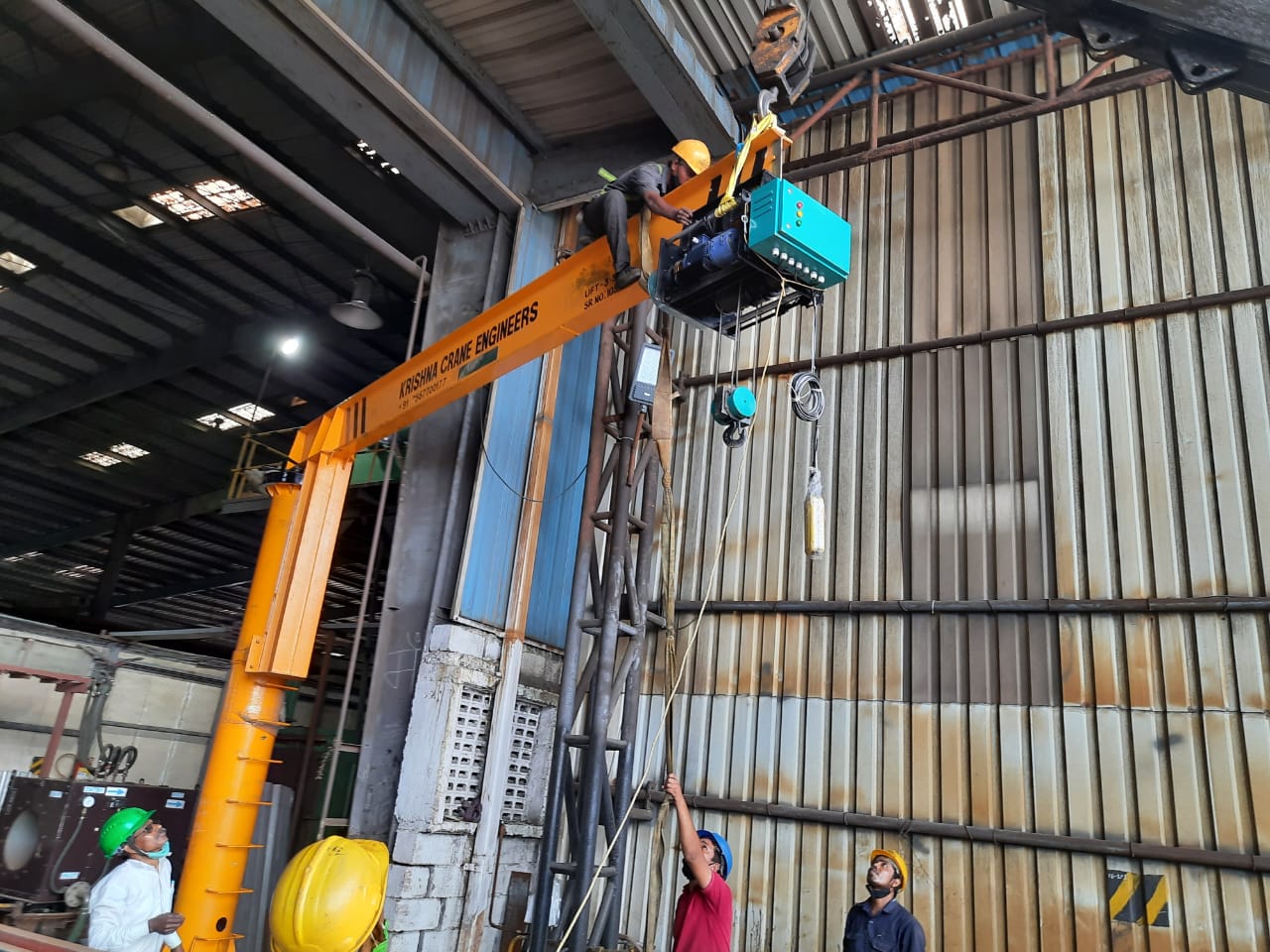
A pillar-mounted jib crane stands on its own steel column, bolted straight into the factory floor. The arm swings freely around this pillar, completely independent of your building.
That’s the biggest advantage: you’re not relying on a wall being strong enough. You just need solid ground.
Key advantages
- Stands alone: works anywhere with a proper foundation
- Wide coverage: decent circular working area
- Flexible placement: can serve one machine or several
- Great for new setups: position it exactly where your workflow needs it
An engineering unit in Ahmedabad, for instance, might install a pillar jib right next to a CNC machine so operators can lift metal parts without waiting on the main overhead crane.
Wall-Mounted Jib Crane: Where Is It Better?
A wall-mounted jib crane bolts onto an existing wall, column, or approved support. No separate pillar, no extra foundation eating up your floor.
That makes it a smart pick when your production floor is already packed tight.
Key advantages
- Saves floor space
- Uses structure you already have
- Fits close to machinery
- Handles repeat lifting at one spot
- Often cuts foundation cost
A fabrication workshop in Surat might mount one right beside a workbench, where the same component gets lifted and rotated all day long, in a tight corner that has no room for a pillar.
Difference Between Pillar and Wall Jib Crane
Here’s the difference between pillar and wall jib crane laid out simply:
- Support: pillar stands alone, wall depends on structure
- Floor space: pillar needs room, the wall frees it up
- Installation: pillar needs a foundation, and the wall needs a strong wall
- Positioning: pillar is flexible, wall is fixed by the structure
- Working area: pillar usually wider, wall more localised
- Best for: pillar suits flexible zones, wall suits, fixed stations
Neither one wins outright. It genuinely comes down to what your factory floor looks like today.
How to Choose the Right Jib Crane for Your Factory
Before you sign off on a purchase, run through these five points with your team.
1. Available Floor Space
Tight floor? Wall-mounted starts looking good. Got room to spare? A pillar-mounted crane gives you more freedom to position it exactly where you need it.
2. Building Structure
Don’t just assume your wall can handle it. Get a proper structural check done before you commit to a wall-mounted system; this step gets skipped way too often.
3. Load Capacity
Think about your everyday lifting load and also the heaviest thing you might lift.
4. Required Working Radius
Measure how far the load actually needs to travel. Get the outreach wrong and half your workstation ends up outside the crane’s reach.
5. Frequency of Use
If it’s running all day on a production line, speed and ergonomics matter a lot. Position it well and you cut down on manual handling across the board.
Common Mistakes to Avoid
Chasing the lowest price tag usually backfires down the line. Watch out for:
- Ignoring wall or column strength
- Picking capacity without checking real load
- Forgetting lifting height needs
- Getting the outreach wrong
- Skipping headroom checks
- Overlooking maintenance access
- Not planning around existing machines
- Treating installation as a last-minute task
Indian safety norms matter here too; get installation and inspection done by people who actually know what they’re doing.
Practical Buying Tips for Indian Factories
Before you reach out to a jib crane manufacturer in India, jot down a few basics first.
Have this ready:
- Maximum load (tonnes/kg)
- Lifting height needed
- Horizontal reach needed
- Rotation angle
- How often it’ll run
- Indoor or outdoor use
- Floor or wall support available
- Power supply details
- Site conditions
Hand over these details and any decent manufacturer can suggest a setup built for your factory, not just a generic model off their price list.
FAQs
- What is the main difference between pillar and wall jib crane?
The difference is in the type of mounting. Pillar crane mounts directly on the independent column fixed to the floor, and wall crane mounts directly on the wall or column. - Which jib crane is better for limited floor space?
Wall-mounted usually wins here since it skips the separate pillar and foundation altogether, freeing up your floor. - Can a wall-mounted jib crane be installed on any wall?
No, because the wall or the column should have sufficient strength to support the weight of the crane. - Are pillar-mounted jib cranes suitable for heavy loads?
Yes, they can be built for a wide range of loads. It just depends on getting the capacity, outreach, foundation, and hoist matched correctly. - How do I choose a jib crane manufacturer in India?
Go with someone who actually studies your application, gives proper technical specs, checks your installation site, and sticks around for after-sales support.
Conclusion
Deciding between pillar-mounted and wall-mounted jib cranes really comes down to your factory’s layout, structure, and how you plan to use it day to day.
A pillar-mounted crane gives you more installation freedom, while wall-mounted models make smart use of what you’ve already got and save precious floor space. Getting clear on the difference between pillar and wall jib crane before you buy saves you from costly mistakes down the road.
Planning a new lifting setup? Talk to the team at Hoistsandcrane about your load requirements and workspace. A proper site assessment goes a long way toward picking the right crane for safe, efficient material handling.